
AI has been influencing every aspect of work. And if you are an HR leader, L&D professional, or organizational decision-maker, there is a good chance you have already felt the pressure: teams experimenting with tools on their own, leadership asking for an “AI strategy,” and no clear roadmap to follow.
The good news? You are not alone and you do not need to figure this out from scratch.
The authors, Ehsan Etezad and Adam Sarty, have developed two practical frameworks (the AI Adoption Matrix and the GRACE Framework) that can give you a clear way to diagnose where your organization stands today, decide where it needs to go, and build a responsible path forward.
Let’s break them down.
The AI Adoption Matrix: Four Quadrants, Four Realities
Think of AI readiness along two dimensions: AI Enablement (how broadly your people can access, use, and build skills with AI tools) and AI Governance (how well your organization manages policies, oversight, and accountability around AI use). Where those two dimensions intersect creates four distinct quadrants.
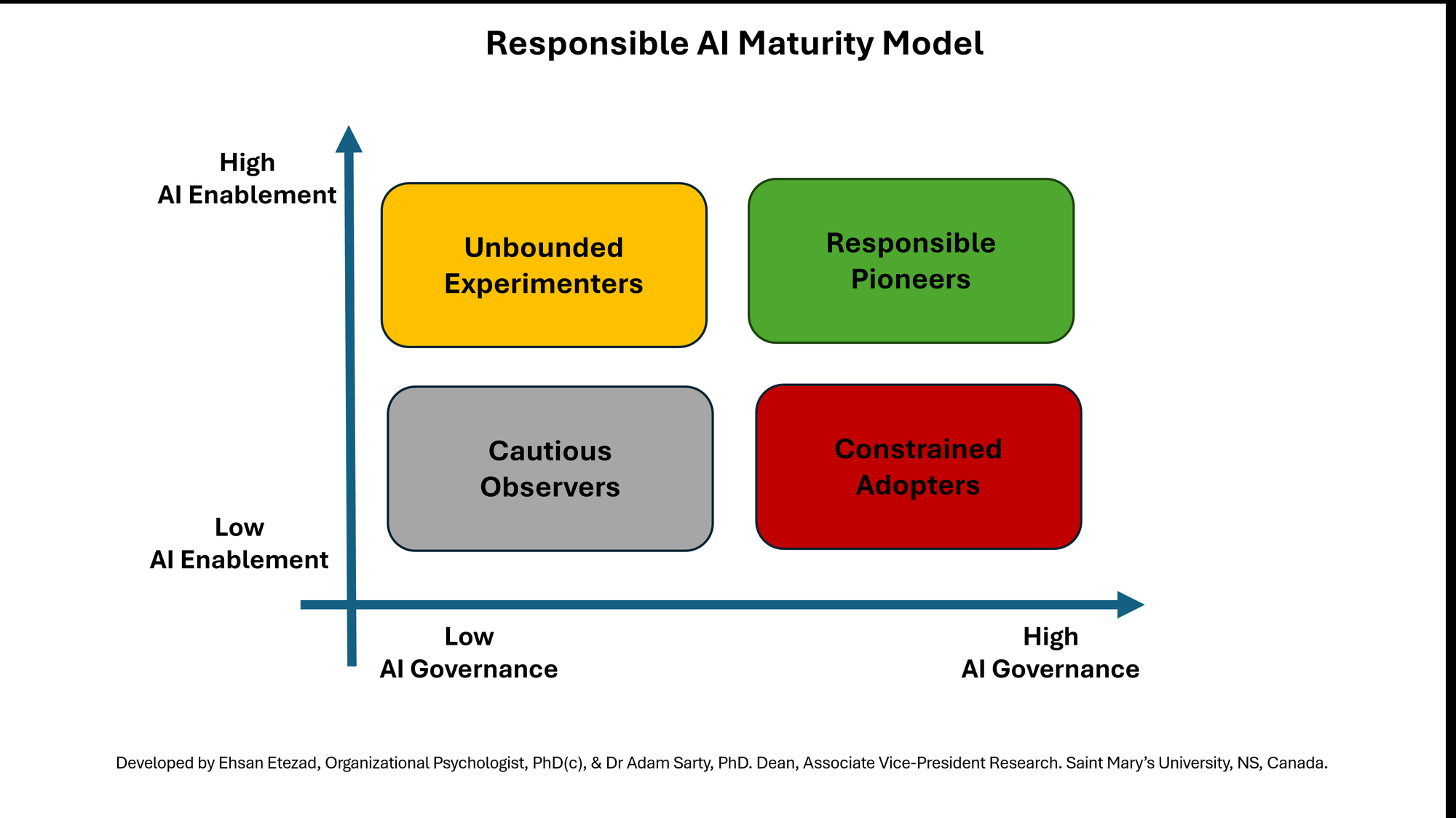
Cautious Observers
Low Enablement, Low Governance
This is the “we’ll deal with it later” quadrant. Limited access to AI tools, no formal policies, and no skills development. An example of this would be a mid-size financial services firm where employees hear about ChatGPT in the news but have no sanctioned tools, no training budget, and no clear rules about what’s acceptable. The risk here isn’t just falling behind competitors. It’s that employees start using AI tools anyway, with zero guardrails.
Constrained Adopters
Low Enablement, High Governance
Strong policies exist, but only a handful of people are actually using AI. Picture a healthcare organization that locked down AI use to the IT department and a small data team. Governance is tight, only approved vendors, clear data handling rules, but frontline staff and managers have no access or training. The result? Efficient risk management, but no innovation. Over time, employees disengage or decide to find a shortcut and use their own personal phone or laptop to access the common AI tools.
Unbounded Experimenters
High Enablement, Low Governance
Energy is high, but structure is missing. A tech startup where every team is experimenting with different AI tools, building their own prompts, even subscribing to separate platforms with company credit cards. Creativity thrives, but so does shadow IT. Data leaks, inconsistent outputs, and duplicated spending are real risks. There’s momentum here, but without governance, it’s unsustainable and it’s a bit risky.
Responsible Pioneers
High Enablement, High Governance
The target for most organizations. Broad access to AI tools is paired with strong oversight. An example would be a large professional services firm that provides organization-wide AI licenses, runs quarterly training bootcamps, maintains a governance committee, and tracks adoption KPIs. Innovation thrives within clear guardrails. Employees feel empowered, leadership has visibility, and the organization builds a sustainable competitive advantage.
Diagnose Your Organization: A Step-by-Step Activity
Before you can move forward, you need an honest assessment. Gather your leadership team and work through these six questions:
1. Where are we today on this matrix, and where do our competitors sit? Be candid. If most employees have no access to AI tools and no policies exist, you’re likely a cautious observer, and that’s okay as long as you don’t stay there.
2. What’s our target quadrant for 12 months from now? 24 months? Not every organization needs to become a Responsible Pioneer overnight. A Cautious Observer might aim for Constrained Adopters first (build governance), then expand enablement. An Unbounded Experimenters might focus on adding governance without killing momentum.
3. Which journey path aligns best with our culture and risk appetite? A risk-averse regulated industry might move from Cautious Observer to Constrained Adopters to Responsible Pioneers. A fast-moving startup might go from Unbounded Experimenters to Responsible Pioneers by layering governance onto existing energy.
4. What are the top three barriers preventing us from moving to our target quadrant? Common ones: budget constraints, leadership buy-in, lack of internal expertise, fear of compliance issues, or simply not knowing where to start.
5. How might different business units be in different quadrants — and why? Your marketing team might be in the Unbounded Experimenters zone while your legal department operates as Constrained Adopters. That’s normal, but you need visibility into it.
6. What would happen if we did nothing and stayed in our current quadrant? This is the question that creates urgency. For Cautious Observers, the answer is usually: competitors pull ahead, top talent leaves, and unsanctioned tool use creates risk anyway.
Moving Forward with GRACE: Five Principles for Responsible AI Adoption
Once you know where you stand, the next question is how to move. The GRACE framework, developed by Ehsan Etezad and Adam Sarty, gives you five actionable principles that balance innovation with accountability.
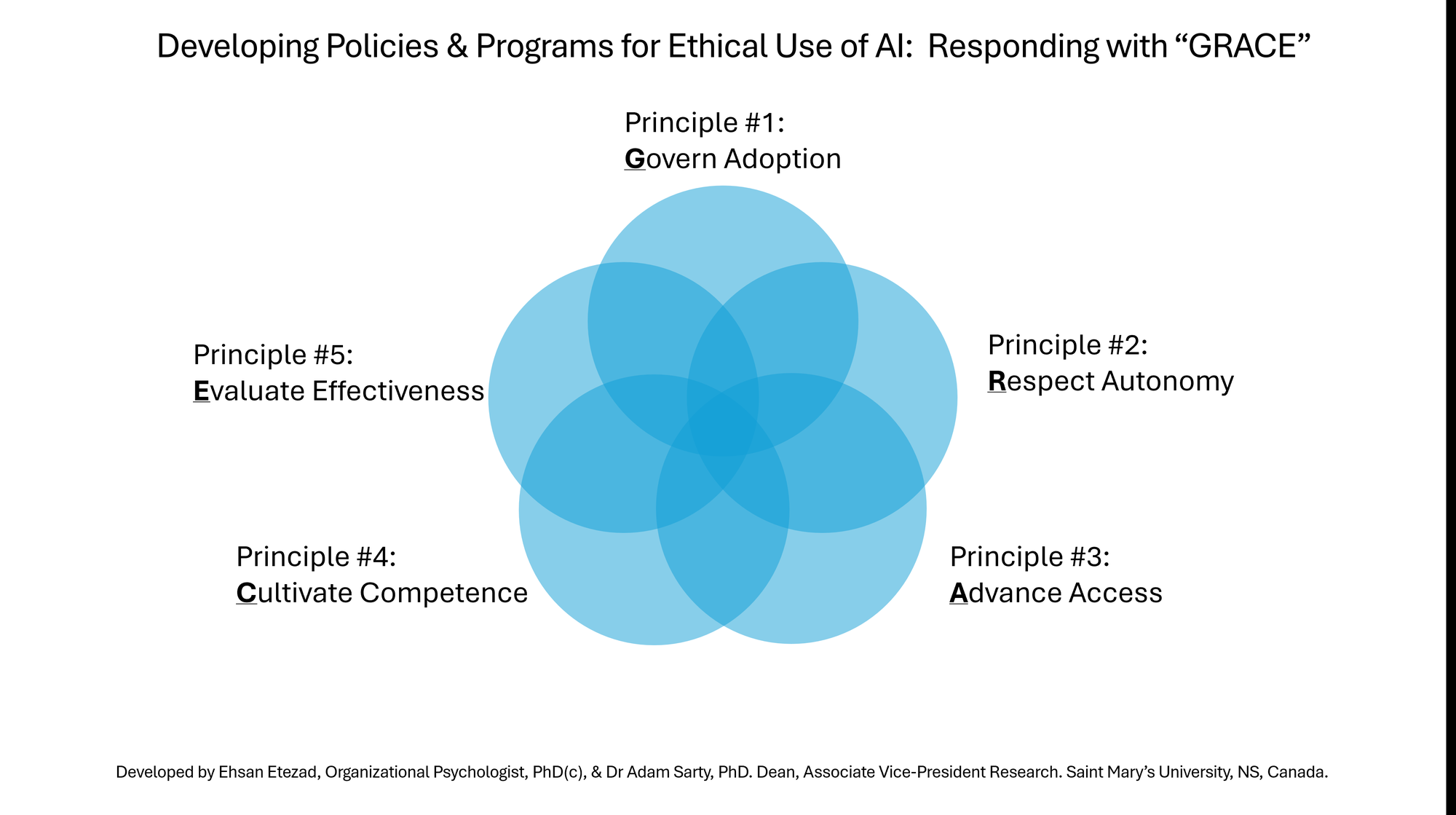
G: Govern Adoption
Establish policies, roles, and oversight to ensure AI is used responsibly and in alignment with organizational values.
In practice: Form a cross-functional AI governance committee that includes HR, IT, legal, and frontline managers, not just executives. Define approved use cases (e.g., drafting internal communications, analyzing employee survey data) and prohibited activities (e.g., using AI for final hiring decisions without human review). A governance committee that meets monthly and publishes clear, jargon-free guidelines gives everyone confidence to move forward.
R: Respect Autonomy
Honor individual decision-making around AI use. Provide guidelines rather than rigid mandates.
In practice: Instead of dictating which AI tool every team must use, create a list of vetted options and let teams choose what fits their workflow. An L&D team might prefer one platform for content creation while a finance team uses another for data analysis. The key is providing boundaries around data privacy and confidentiality while leaving room for creativity and exploration. People adopt tools faster when they have a say in what they use.
A: Advance Access
Ensure equitable, broad access to AI tools and support resources across the organization.
In practice: Negotiate organization-wide licenses so AI tools aren’t limited to one department. Build an internal AI resource portal with tutorials, prompt libraries, and datasets. Offer drop-in help sessions, think “AI office hours,” where employees can bring real work problems and get hands-on support. Access isn’t just about software licenses; it’s about making sure everyone, regardless of role or technical background, can participate.
C: Cultivate Competence
Build skills so your people can apply AI effectively, safely, and creatively.
In practice: Integrate AI literacy into existing onboarding and professional development programs rather than treating it as a separate initiative. Run hands-on bootcamps focused on real job tasks, not abstract theory. Create a peer mentor “AI Champions” program where early adopters in each department support their colleagues. This is where peer learning becomes powerful, people trust and learn from coworkers who face the same daily challenges.
E: Evaluate Effectiveness
Continuously measure impact, outcomes, and risks to inform improvement and accountability.
In practice: Track adoption metrics (how many employees are actively using AI tools), usage patterns (which tasks, which departments), and outcomes (time saved, quality improvements). Conduct regular surveys on employee satisfaction with AI tools and training. Audit AI outputs for fairness, bias, accuracy, and compliance. The goal isn’t just measurement for measurement’s sake, it’s using data to optimize your investment. As one principle from this framework puts it: you don’t necessarily need to spend more, but you definitely need to spend better.
Practical Recommendations to Start This Week
You don’t need a perfect strategy to begin. Here are high-impact moves you can make now:
(1) Role model it. If you’re a leader, use AI tools visibly. Share what you’re learning. When leadership engages with AI publicly, it signals that experimentation is welcome.
(2) Recognize good behavior. Add an AI innovation category to your employee newsletter or team meetings. Celebrate people who find creative, responsible uses.
(3) Involve employees in decision-making. Don’t build your AI policy in a closed room. Bring frontline voices into the conversation, they know where the real opportunities and risks are.
(4) Ask about it in every meeting. Make AI a standing agenda item. “How is AI showing up in your work this month?” normalizes the conversation.
(5) Frame it as growth. Position AI adoption as a professional development opportunity, not a mandate. People engage more when they see personal benefit.
(6) Embed it in existing programs. Weave AI topics into coaching, mentoring, and leadership development rather than creating yet another standalone initiative.
(7) Make sure nobody gets punished for experimenting. Psychological safety is non-negotiable. If someone tries an AI tool and it doesn’t work out, that’s learning, not failure.
(8) Define KPIs and track progress. You can’t improve what you don’t measure. Set clear targets for adoption, competence, and governance maturity, and review them quarterly.
Your Next Step
Take 30 minutes this week to plot your organization or your department on the AI Adoption Matrix. Be honest about where you are. Then pick one GRACE principle to focus on for the next 90 days. Build from there.
AI adoption doesn’t require a massive transformation initiative. It requires clarity about where you stand, intention about where you’re headed, and a framework that keeps innovation and accountability in balance.
If you would like to explore these frameworks further, discuss how they apply to your organization, or bring this work to your leadership team, reach out to the first author, Ehsan Etezad.
Dr. Ehsan Etezad is a Vancouver-based Organizational Psychologist. He is the Co-Founder and CEO of MEUS Science Corp. He collaborates with regulators, research institutions, and private companies to enhance psychological health and safety, leadership, and team productivity. Ehsan is also the producer and director behind the well-known interview series “How Do You Recharge with Ehsan Etezad”, where he explores how inspiring professionals build successful businesses and careers without sacrificing their well-being. With over 22 peer-reviewed research publications, he also mentors HR professionals through the CPHR program. His newsletter, Weekly Performance Science, reaches over 16,000 leaders globally. You can connect with Ehsan on LinkedIn, or send him a direct email at ehsan@withmeus.com
Dr. Adam Sarty holds a PhD in experimental nuclear physics and completed postdoctoral research at MIT. A 3M National Teaching Fellow and past President of the Canadian Association of Physicists, he serves as Dean and Associate Vice-President Research at Saint Mary’s University, championing research, teaching excellence, and science outreach.